
How the right hydraulic components keep vehicles secure on a car transporter
On a car transporter, vehicles are stacked above one another. Each deck is lifted by two cylinders, one on the left and one on the right. If they do not run in sync, the deck tilts and a vehicle can slide off the side. So, the question is not just how to raise the deck. It is how to make sure both sides do the same thing, under every load and on every trip.
Equal movement under unequal loads
The load is never evenly distributed
A vehicle rarely sits exactly in the middle of a deck. The engine is at the front, one car is heavier than the next, and the load changes with every trip. One cylinder always carries more than the other.
Why equal pressure is not enough
Hydraulic oil takes the path of least resistance. If you connect two cylinders to the same pump without any additional control, the cylinder with the lightest load rises first. The deck is already out of level before the driver notices anything.
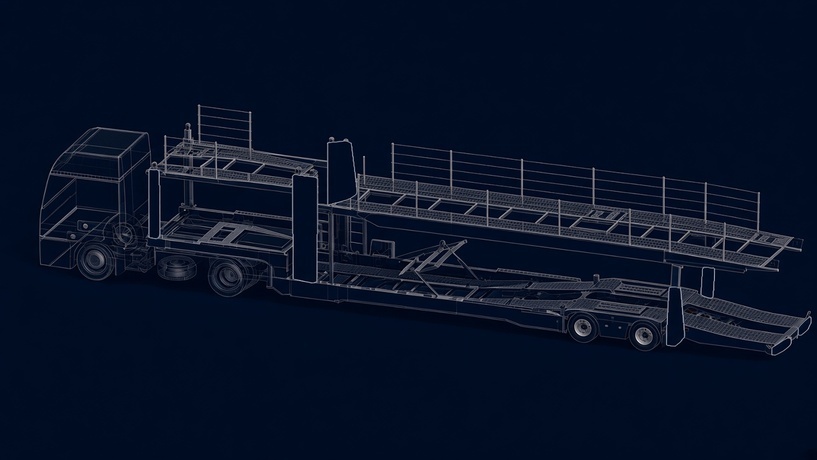
How a flow divider keeps both cylinders in sync
The working principle
The solution is a flow divider. It has one inlet and two outlets. If 40 litres per minute go in, it delivers 20 litres per minute to the left cylinder and 20 litres per minute to the right.
Inside the flow divider, a small spool moves back and forth. When one side meets more resistance, the spool shifts and slightly restricts the other outlet. This keeps the flow to both cylinders equal, regardless of how the load is distributed across the deck.
How accurate is it?
In practice, the deviation stays within a maximum of 1.5 centimetres per metre of stroke. For a deck carrying vehicles, that is well within what is needed to lift steadily and level.
Eight to ten in one machine
A car transporter does not make one movement but a whole series of them. There are several decks, tilt functions and ramps, and wherever two cylinders work together on one movement, synchronisation is needed. A complete transporter easily contains eight to ten flow dividers. They are usually mounted centrally in the machine, where the supply lines to the cylinders start.
Holding position matters as much as lifting
A deck that rises smoothly also has to stay where it is. That is why each cylinder, left and right, has a load holding valve. The valve has three tasks:
- Holding position. Once the deck is at height, the cylinder stays there, even when the pump is off.
- Protection against failure. If pressure drops or a line fails, the upper deck does not come down on the vehicle below.
- Controlled lowering. The load cannot retract the cylinder faster than the oil flows out.
Why the valve sits on the cylinder
The load holding valve is mounted directly on the cylinder, not at the pump. That way it still protects the load if the line between pump and cylinder fails. The safety function sits as close to the load as possible.
Standard where possible, selection where it counts
Custom work is the exception
On car transporters, a standard component is often sufficient. That does not mean any flow divider will do. A flow divider works accurately within a specific flow range. If it is too large or too small for the application, the deviation increases.
What we look at
When selecting components, we work out with you:
- the flow the pump delivers and the cylinders require
- the stroke and the accuracy the application needs
- how the load is distributed and how much it varies
- how the flow divider works together with the load holding valves and the rest of the circuit
That is where the real work lies. We look at the system, not at a single component.
The same principle beyond car transport
The same principle applies wherever two or more cylinders make one movement together. Think of a lifting platform, a hydraulically height-adjustable work table, or a platform that has to stay level under uneven loads. The application differs, but the challenge is the same, equal movement under unequal loads.
Discuss your car transporter
Working on a new car transporter or improving an existing one? Send us your drawings and specifications. Together we work out the best hydraulic setup for your design and stay involved until it works.


