
What it takes to lower an aerial work platform smoothly and safely
An aerial work platform lifts a person, holds them at height and brings them back down. Every one of those movements depends on valves that keep the cylinders in position. On paper, an overcenter valve and a pilot check valve can both do that. On the machine they behave very differently.
The difference shows up on the test rig as a boom that lowers in jerks or a platform that creeps down, which is exactly where you do not want it with a person on board.
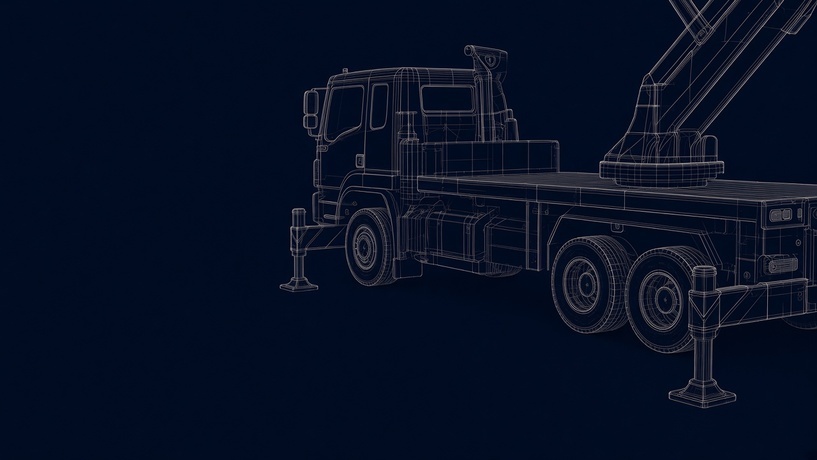
One machine, several holding functions
Different functions, different loads
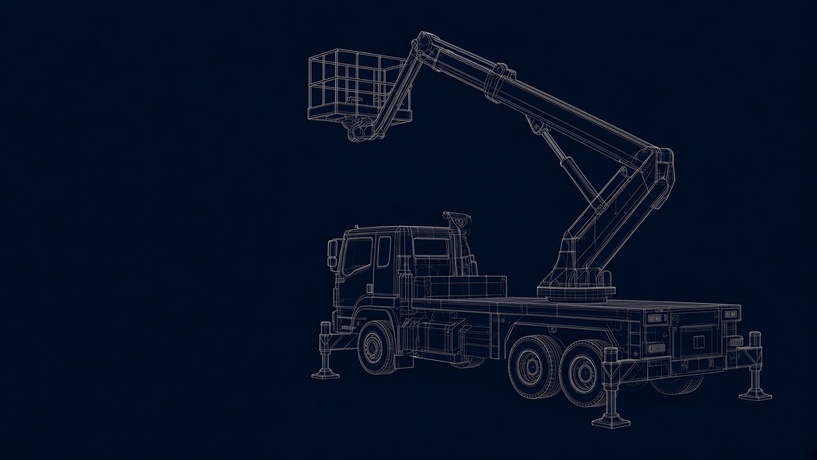
An aerial work platform is not one hydraulic function but several, and each puts different demands on the holding valve:
- The boom and lift cylinders carry the platform with the operator and lower a load that pushes the cylinder in the direction of travel.
- The outriggers stabilize the machine and mainly have to hold position, often for hours, while nobody operates them.
- The slewing drive turns the upper structure with a hydraulic motor in the slewing ring, while a rotary union with electrical slip rings carries oil and signals through the center.
The right holding valve therefore depends on the function, not on the machine as a whole.
Why the boom needs an overcenter valve
Lowering with a person on the platform
When the boom comes down, gravity pushes the cylinder in the same direction as the movement. This is an overrunning load. With a pilot check valve, the load can move faster than the pump fills the opposite side. The pilot pressure drops, the valve closes, pressure builds up and the valve reopens. The result is jerky lowering and chatter, which is unacceptable with a person on the platform.
An overcenter valve works differently. It creates back pressure on the outlet side of the cylinder and modulates the outflow. The boom moves at the speed the operator controls, not at the speed the load dictates.
Smooth control from the operator’s lever
The operator moves a lever and expects the platform to follow calmly. With proportional control, the flow to the cylinder follows the position of the lever. That only works when the holding valve does not undo it.
If the cylinder extends or retracts abruptly, the operator is thrown around in the basket. The overcenter valve makes proportional control work as intended.
Mounted on the cylinder, always
On manned aerial work platforms, the overcenter valve is mounted directly on the cylinder. If a line between the valve block and the cylinder fails, the boom still stays in place.
On simple vertical lifts with a power pack at the base, holding valves are sometimes placed in the power pack. With a person on the platform, the valve belongs on the cylinder.
Why outriggers can use a pilot check valve
Outriggers are deployed before work starts and retracted afterwards. In between, they only have to hold position. The movement is slow, nobody is on the platform when they move, and smooth lowering is less critical. A pilot check valve is well suited here. It seals tightly, holds position for long periods and is simpler than an overcenter valve.
The pilot ratio and the battery
The pilot ratio of an overcenter valve determines how much pilot pressure is needed to open it. A low ratio gives stable, calm movement under varying loads, but requires more pump pressure. A high ratio is more energy efficient but responds more sharply.
On diesel-powered machines, that extra pressure mainly shows up as heat. On battery-powered aerial work platforms, it shows up as operating time. Every bar of unnecessary pressure drains the battery. As more aerial work platforms go electric, the choice of pilot ratio becomes a trade-off between stability and range.
The directional valve completes the picture
A holding valve only closes reliably when its pilot pressure can drain. If the directional valve blocks the cylinder ports in neutral, pressure can stay trapped and hold the overcenter valve partly open. The platform then creeps down while the operator thinks the machine is standing still. That is why we always select the holding valve together with the directional valve, never separately.
What we look at
When selecting holding valves for an aerial work platform, we work out with you:
- which functions carry an overrunning load and which mainly hold position
- how smooth the movement has to be at the platform
- how much the load varies between an empty and a fully loaded basket
- which directional valve the circuit uses in neutral
- how much pressure loss the drive, diesel or battery, can absorb
Discuss your aerial work platform
Developing a new aerial work platform, or seeing unstable lowering on the test rig? Send us your circuit and load data. Together we work out the right holding valve for each function and stay involved until it works.


